
|
Sam Eldin Artificial Intelligence
Plans, Strategies and Roadmap Framework© |
|---|
|
AI Plans, Strategies and Roadmap Framework Introduction: IT, AI, science, or research professionals use many terms interchangeably plus the overlapping of the meanings and the definition of these terms may cause a lot of confusion and lack of precisions. We would like to present the following: Difference between Plan, Strategy and Roadmap Framework? What is the difference between Plan and Strategy? Our views are: A Plan says "here are the steps (processes)." While a strategy says "here are the best steps (processes)." And a Roadmap Framework says "here is the details, the timeline and the milestones of all the processes." AI Plan, Strategy and Roadmap Framework Structure: We are architecting-designing a structure for AI Plan, Strategy and Roadmap Framework. Having a picture is the best way to have all of our audience see our approaches and thinking. Image #1 is our attempt to have a picture of Plan, Strategy and Roadmap Framework structure. 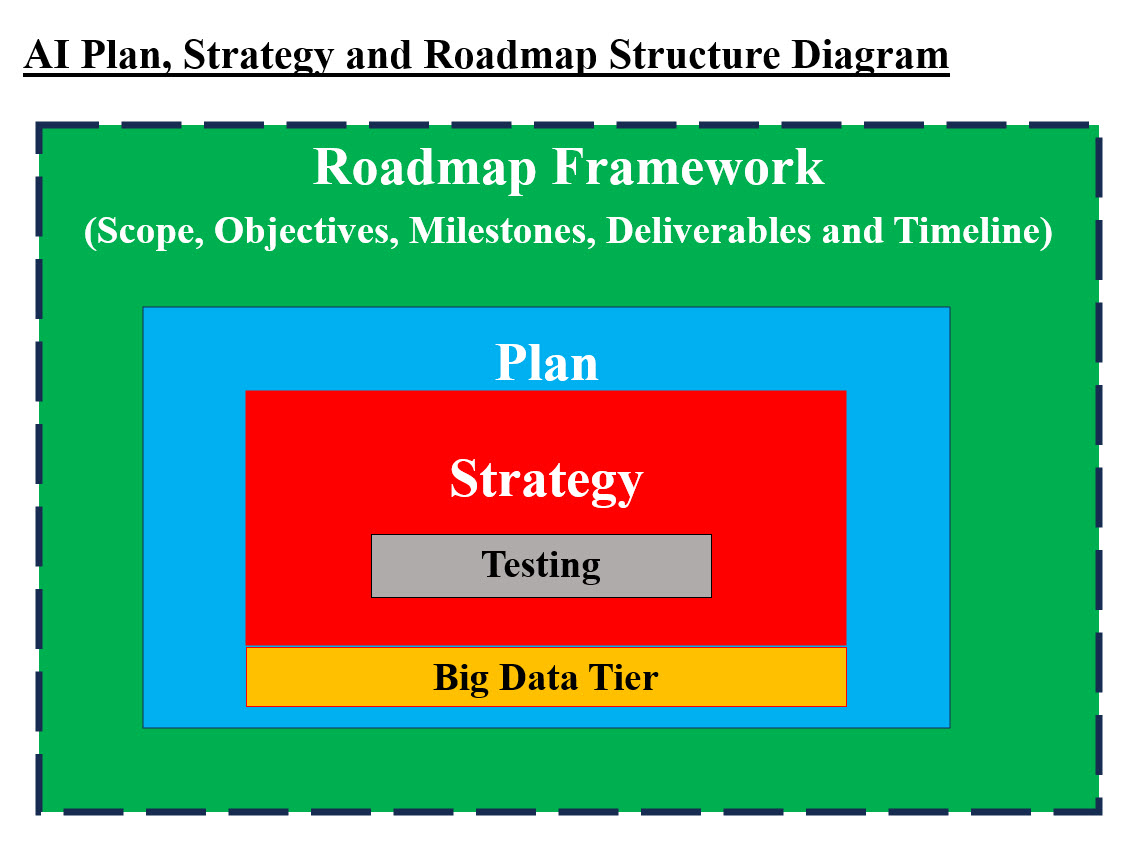
Image #1 - Difference between Plan, Strategy and Roadmap Framework Structure Image Image #1 presents a rough picture of our views of Plan, Strategy and Roadmap Framework. The Roadmap framework would develop Scope, Objectives, Milestones, Deliverables and Timeline. The Roadmap framework would include the Plan. The Plan would encompass the Strategy and Big Data. The Strategy would have the testing. Before the Plan, Strategy and Roadmap Framework, we need to define the project-building components as follows: Goals – what we need to accomplish Resources – with what we would be able to accomplish Governance - compliance, legal, and business teams to maximize benefits and prevent harm Management – who runs the show Development teams – the needed foot-soldiers and their talents There is should be clear definition of these project-building components for Plan, Strategy and Roadmap Framework to take any shape or form. AI Main goals: The primary goals of artificial intelligence include: 1. Simulation of Human Intelligence 2. Achieving Autonomous Behavior 3. Automating repetitive tasks 4. Enhancing decision-making 5. Driving Innovation 6. Natural Language Processing (NLP) 7. Learning and adapting from data 8. Enabling human-AI collaboration 9. Solving complex problems. Our AI Plan: AI planning aims to achieve specific, desired outcomes. Actions: It involves selecting and sequencing actions to transition from the initial state to the goal state. States: Planning problems are often represented as a state-transition system, where each state represents the current condition of the system. Problem Definition: Defining the initial state, the desired goal state, and the available actions. Business: Planning for resource allocation, scheduling, and forecasting. State Space: Representing the possible states of the problem, either explicitly or implicitly. Search Algorithms: Employing algorithms like search and optimization to find a solution in the state space. Actions: Defining the possible actions that can be taken to transform the state. Constraints: Incorporating constraints that limit the possible actions or states. Our AI strategy: Our strategy would be achieving our AI Goals. Our AI Strategies: 1. Defining Business Goals 2. Assessing Current State 3. Identifying Use Cases 4. Roadmap and Implementation 5. Performance Measurement 6. Ethical and Legal Considerations 7. Data Management 8. Talent Development 9. Data and Technology Infrastructure 10. Scalable Infrastructure 11. Data Preparation 12. Using AI Algorithms 13. Change Management 14. Organizational Readiness 15. Adoption and Integration 16. Scaling AI Initiatives 17. AI Action Plan 18. Accelerating AI Strategy 19. Testing and Iteration 20. Lessons Learned Our Web Strategy: 1. Infrastructure 2. Develop AI Responsibly 3. Data Strategy 4. Government Application of AI 5. A Mechanism for Prioritizing AI Initiatives 6. An AI Center of Excellence 7. Assess Data Quality 8. Ethical AI Deployment 9. Improved Decision-Making 10. Prioritize Business Goals 11. Readiness Assessment 12. Risk Mitigation and Outcome Prediction Our AI Roadmap Framework: Map: A map is a visual representation, usually on a flat surface, showing the features of an area, like a city, country, or the world, and their locations, such as roads, buildings, and natural features. A Project Roadmap Framework: A project Roadmap Framework is a visual, high-level overview of a project's major elements and timeline, focusing on objectives, milestones, and deliverables. It's a strategic tool that helps project stakeholders understand the project's direction, progress, and key activities at a glance. AI Roadmap Framework: An AI Roadmap Framework is a strategic plan that outlines how an organization will implement and scale AI technologies to achieve specific business goals. It's a guiding framework that aligns AI initiatives with overall business objectives, manages resources, and prioritizes activities. A project Roadmap Framework is a visual, high-level overview of a project's major elements and timeline, focusing on objectives, milestones, and deliverables. It's a strategic tool that helps project stakeholders understand the project's direction, progress, and key activities at a glance. In a nutshell, AI or Project Roadmap is the needed details which would include the timeline and the milestones of all the processes. Key Components of an AI Roadmap Framework are: 1. Data Handling 2. Visual Representation 3. High-Level Overview 4. Strategic Tool 5. Communication and Alignment 6. Progress Tracking 7. Objectives and Goals 8. Milestones 9. Deliverables 10. Timeline 11. Resources 12. Risk Assessment 13. Metrics for Success 14. Phases |
|---|